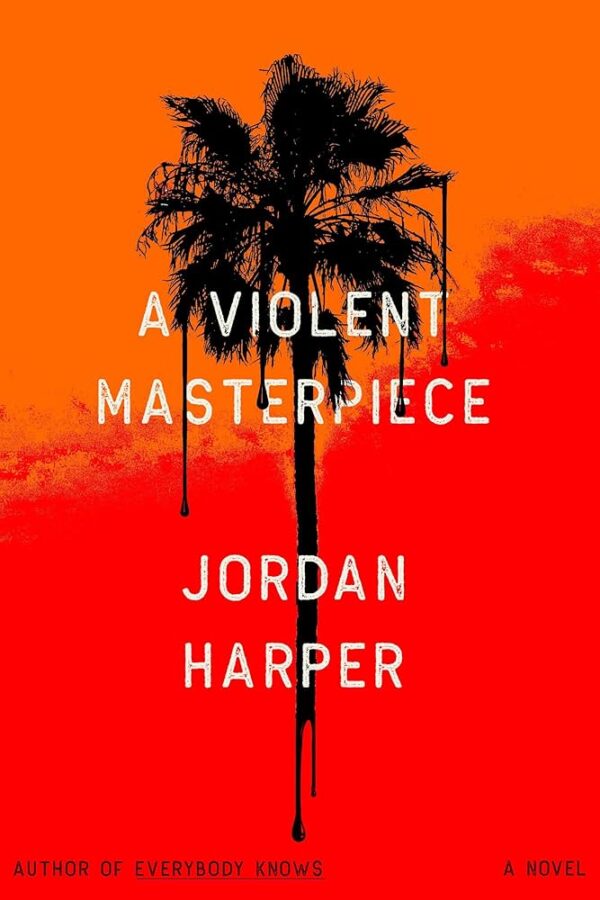
Jordan Harper’s New Novel Really Is “A Violent Masterpiece”
I’ve been reading Jordan Harper’s “A Violent Masterpiece,” and I’m calling it now: this is the best crime novel of the year. It’s a buzzing, screaming, bullet-quick plunge into the worst parts of Los Angeles. Rich people doing messy, evil things. Nightstalker journalists cruising the highways and byways. Black-bag PR and body cleanup. Serial killers and mercenaries.
At first read, the staccato rhythms and the terminally damaged characters might remind you of a James Ellroy book, except “Masterpiece” feels more vital than anything Ellroy has written in years; the self-styled demon dog of crime fiction seems incapable of moving his narratives out of the mid-20th century, which—despite the druggin’ and shootin’ and cussin’—makes them seem increasingly antique.
Harper, on the other hand, is unafraid to bind his fiction to the current moment. There’s a nasty character who’s an obvious stand-in for Jeffrey Epstein, and his death kicks off a maelstrom. Without becoming preachy and pedantic, the book also sprints headfirst into issues like police brutality, income inequality, decaying infrastructure, and more. It’s political, and frankly, that’s exactly what we need at this current moment. How else can we process everything going on, distill the spirit behind it all?
Too much crime fiction, particularly bestselling crime fiction, seems intent on divorcing itself from the chaos outside our front doors—resulting in airless, gray repeats of stuff we’ve been reading for decades.
(“But Nick,” you scream. “Not all crime fiction needs a political bent! Simenon wrote novels set during the French Occupation and never mentioned the Nazis once!”
(Yeah, except the Nazis would’ve shot or jailed Simenon otherwise, and he knew it. As a country, we’re not there. Yet.)
While reading “Masterpiece,” I made the mistake of watching Barton Layton’s “Crime 101,” based on the Don Winslow novella. As a movie, it’s fine—a high-end robber finds himself pressured by the LAPD and his own fence; there’s cinematography that’s a bit too self-consciously Michael Mann, and one good car chase—but in comparison to Harper’s book, its portrayal of LA seems particularly inert. Even when the cops questionably shoot a suspect, it’s treated with a shrug, a way to provide a blip of extra motivation for another character. Harper would have burned the city down.
The movie’s bright spot is Chris Hemsworth as Mike, the thief protagonist. On paper, Mike is a 21st century clone of Frank, the safecracker in Mann’s “Thief,” or even De Niro’s Neil McCauley in “Heat.” But Hemsworth (who’s a better actor than people give him credit for) realized that a Mann-style smooth operator is likely, underneath it all, a neurotic wreck; his thief is good at his job but barely keeping himself on an even keel, psychologically speaking. His twitchy, tense performance adds a compelling nuance that the rest of the film doesn’t really deserve.
In any case, if you’re looking for an intense book—filled with sentences polished into dark little jewels—track down Harper’s novel.
(Anmerkung d. Red: Jordan Harpers „A Violent Masterpiece“ erscheint nächstes Jahr, übersetzt von Conny Lösch, in der TW-Edition bei Suhrkamp.)
** **

Nick Kolakowski is the author of several crime novels, including “Where the Bones Lie”, “Payback is Forever”, „Maxine Unleashes Doomsday“ and „Boise Longpig Hunting Club“ as well as the Love & Bullets trilogy of novellas. His work has been nominated for the Anthony and Derringer awards, and his short story “Scorpions” appeared in The Best Mystery and Suspense 2024. His short fiction has appeared in numerous anthologies and magazines, including Mystery Weekly, Shotgun Honey, Rock and a Hard Place Press, and more.
Just out: RIGHTEOUS TRASH, the third book in what is called the Boise Noir Trilogy. Rock and a Hard Place Press did a masterful job on the cover (as they did with the reissued editions of the first two books in the trilogy, BOISE LONGPIG HUNTING CLUB and RATTLESNAKE RODEO).
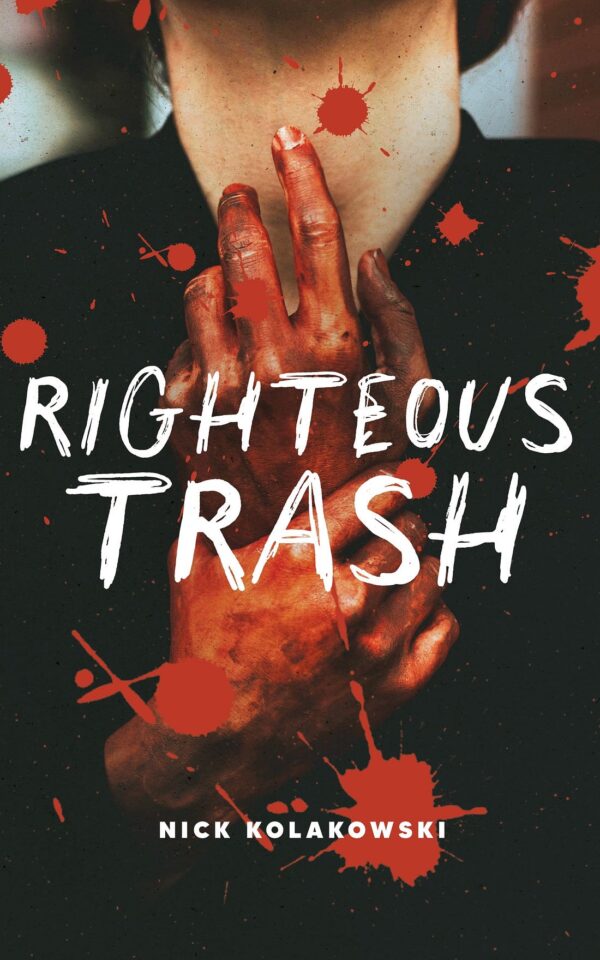
RIGHTEOUS TRASH follows Jake, an Iraq War veteran and former bounty hunter, and his gun-running sister Frankie as they try to dig themselves out of a big financial hole the only way they know how—by doing something incredibly insane and possibly deadly. »This time around, the action isn’t restricted to Idaho; there’s also a sequence set in New Orleans that’s a.) based on a real-life incident, if you can believe it, and b.) one of the funnier things I’ve written. The book’s centerpiece is also the craziest robbery I could think of—I had a lot of fun orchestrating that bit of chaos.«
His „Payback is Forever“ (Shotgun Honey 2022) is inspired clearly by the novels of Richard Stark. Our review here (in German). – See also his Hell of a Mess. A Love & Bullets Hookup.
Nick Kolakowski, geboren 1980, aufgewachsen in Washington. D.C., hat Geschichte in Chicago studiert. Er schreibt Romane, Kurzgeschichten, Lyrik und Essays, viele davon über Crime Fiction und verwandte Themen. Seine Texte erscheinen u. a. in der Washington Post, in Shotgun Honey, North American Review, The Evergreen Review, Rust & Months. Kolakowski lebt in New York City. Eine Besprechung des von Parker inspirierten „Payback is Forever“ in unseren Bloody Chops.

Bei Suhrkamp auf Deutsch: Love & Bullets.
His essays with us.
His website nickkolakowski.com
His column „Smoking Gun“ with us:
‘Salem’s Lot’ and the Horror of a Stephen King Adaptation
(27) „Rebel Ridge“: Calmly Burn the Whole Thing Down
‘Monsieur Spade’ and the Faustian Bargain
John Woo is Remaking ‘The Killer.’ But Why?
The Newest ‘Ripley’ Series is Stunning and Flawed
‘Sugar’: Not the Neo-Noir Revival We Need
(3) Moral Redemption in Noir: Is It Possible?
(4) What Makes Jack Reacher Tick?
(5) ‘True Detective: Night Country’ Tries to Make the Familiar into Something New
(6) Is David Fincher’s ‘The Killer’ a Comedy?
(7) Rewatching ‘Drive’: Gosling as Noir’s Apex Predator
(8) Elmore Leonard – City Primeval
(9) Cormac McCarthy Used Crime Fiction’s Tropes to Make Masterpieces
(10) Parker: Donald Westlake’s One Amazing Trick
(11) Cosby, Winslow, Pruitt: Three Heavy-Hitting Thillers for Summer
(12) Weed-Based Crime Thrillers are Going Up in Smoke
(13) ‘The Last of Us’: Crime in the Post-Apocalypse
(14) What Made “Glass Onion” and “Knives Out” So Popular?
(15) Jordan Harper’s One-Two Punch of Crime Fiction Deserves a Wide Audience
(16) ‘True Detective’ Season 2: Was It Better Than We All Thought?
(17) From ‘Touch of Evil’ to ‘True Detective,’ Long Shots are Crime Films’ Secret Weapon
(18) Michael Mann, again: What Michael Mann Teaches Us About Enduring Crime Fiction
(19) „Heat 2“ – How Do You Craft a Sequel to a Masterpiece?
(20) 4 Ways Tarantino’s “Once Upon a Time in Hollywood” Novel Stands Out From the Film.
(21) On „Heat“: Manhunter Takes Down Thief: How Michael Mann’s Early Career Led to ‘Heat’
(22) The Most Honest Nihilism – on „The Way of the Gun“
(23) No, Time to Die – The latest James Bond movie digs into the fatalism at the iconic spy’s core.
(24) Cormac McCarthy’s Overlooked Masterpiece? – „The Councelor“
(25) „Nightmare Alley“ – How Guillermo del Toro’s Film Alters a Masterpiece Noir Novel
(26) David Cronenberg – The Carnal Crime of “A History of Violence” and “Eastern Promises”
(27) With Parker, Donald E. Westlake Pulled Off Crime Fiction’s Most Spectacular Magic Trick
(28) Guy Ritchie’s Return to Crime Films is Worth Watching
(29) Alex Garland’s ‘Civil War’: Hint of Things to Come?
(30) David Lynch and the Beautiful Weirdness
(31) ‘Where the Bones Lie’ and the Engine of California Noir
(32) “Den of Thieves 2”: Stealing from the Best
(33) White Lotus and the Gentle Art of Hating Your Protagonists
(34) Neal Stephenson
(35) Where is Storytelling Going?
(36) ‚She Rides Shotgun‘ and the Making of Legends
(37) Jack Bauer, ‘24’ and the Great Memory-Hole
(38) How “Play Dirty” Did Richard Stark’s Parker Dirty
(39) ‘The Lowdown,’ Jim Thompson and the Ghosts of Noir
(40) “The Rip”: An Atypical Director Delivers a Typical Crime Thriller
(41) ‚Cape Fear‘ and Pop Cultural Eternal Return
(42) 3 x »Man on Fire«
(43) ‚The Black Dahlia‘ and Our Responsibility to the Past