‘Neuromancer’ and the Old New Cyberpunk
An adaptation of William Gibson’s “Neuromancer” is due to hit our collective television screens later this year, courtesy of Apple TV. If you’ve never read the original novel, and you’re interested in high-tech heists that take place within a burned-out urban dystopia, it’s well worth your time; for many writers of my generation, it was an inspirational text.
I’m not here to praise or damn what’s coming based on a few minutes of footage. I do think it’s interesting that cyberpunk, the literary sub-genre that “Neuromancer” helped create, is having a bit of a moment, in large part because of everyone playing “Cyberpunk 2077,” a video game based off a board game that came out in 1988, four years after Gibson’s novel. A cursory search online also reveals an infinite number of self-published cyberpunk novels, all hitting the same themes (evil mega-corporations, cybernetic augmentation, cutting-edge criminality), most reading like reheated pastiches of “Akira.”
What’s behind all this? I’d say it’s a hankering for a different kind of anti-utopia outside our windows.
When “Neuromancer” hit, the internet was a digital zygote, a way for military and academic networks to chatter amongst themselves; Japan was flexing its economic and cultural muscles; fears of corporatization were gaining speed. Gibson might have been influenced by writers like JG Ballard and William S. Burroughs, but the writers inspired by Gibson took all of those real-world signals and decided the future was essentially a toxic version of 1980s Tokyo, with more high-tech weapons and snarky cyborgs walking around.


While Japanese creators embraced the genre hard—the aforementioned “Akira,” “Ghost in the Shell,” etc.—Americans traditionally haven’t brought the same level of enthusiasm, at least when it comes to movies and TV. Previous attempts to make “Neuromancer” into a movie crashed and burned. “Johnny Mnemonic” (1995), based off one of Gibson’s cyberpunk short stories (and directed by painter Robert Longo, by his own admission biting off more than he could chew) was an interesting mess that tanked at the box office. “Ghost in the Shell” (2017), a live-action adaptation of the anime, was also a dud, despite Scarlett Johansson doing her best.
(You’re going to say “The Matrix” (1999) is an exception to this, and I’m going to tell you that, while the Wachowski sisters borrowed quite a number of cyberpunk ideas for their magnum opus, it isn’t a cyberpunk work per se.)

Cyberpunk predicts a bad future, but also an entrepreneurial one. It says that even the biggest loser can buy a bionic eye or an augmented hand that will give them the vision and power of a tiger; that anyone with a little moxie and a lot of guns can climb to the top of a soulless conglomerate; that there’s often a way out, either through the neon world of cyberspace or a slice of paradise you can purchase. Contrast that with our reality, where many people—particularly the young’uns—feel like they’re spinning their proverbial wheels, where too much of our technological know-how seems devoted to churning out shinier versions of the social-media apps draining our attention.
Which is why I think, if its quality holds up, the new “Neuromancer” might be a hit. A big chunk of the audience might see Case, its antihero protagonist (and one hell of a cyber-jockey) as aspirational.
It’s also interesting to note that Gibson himself moved beyond cyberpunk into other realms of speculative fiction. His novel “The Peripheral” (2014) is another favorite of mine, and it’s eerily predictive of what might be coming. It incorporates quantum computing, nanotechnology, and parallel timelines—and plays with the idea that our apocalypse will be a gradual process rather than a theatrical bang (referred to as the Jackpot). If cyberpunk is oddly comforting, his later vision is terrifying because it’s our world altered by a few degrees.
** **
Nick Kolakowski is the author of several crime novels, including “Where the Bones Lie”, “Payback is Forever”, „Maxine Unleashes Doomsday“ and „Boise Longpig Hunting Club“ as well as the Love & Bullets trilogy of novellas. His work has been nominated for the Anthony and Derringer awards, and his short story “Scorpions” appeared in The Best Mystery and Suspense 2024. His short fiction has appeared in numerous anthologies and magazines, including Mystery Weekly, Shotgun Honey, Rock and a Hard Place Press, and more.
Just out: RIGHTEOUS TRASH, the third book in what is called the Boise Noir Trilogy. Rock and a Hard Place Press did a masterful job on the cover (as they did with the reissued editions of the first two books in the trilogy, BOISE LONGPIG HUNTING CLUB and RATTLESNAKE RODEO).
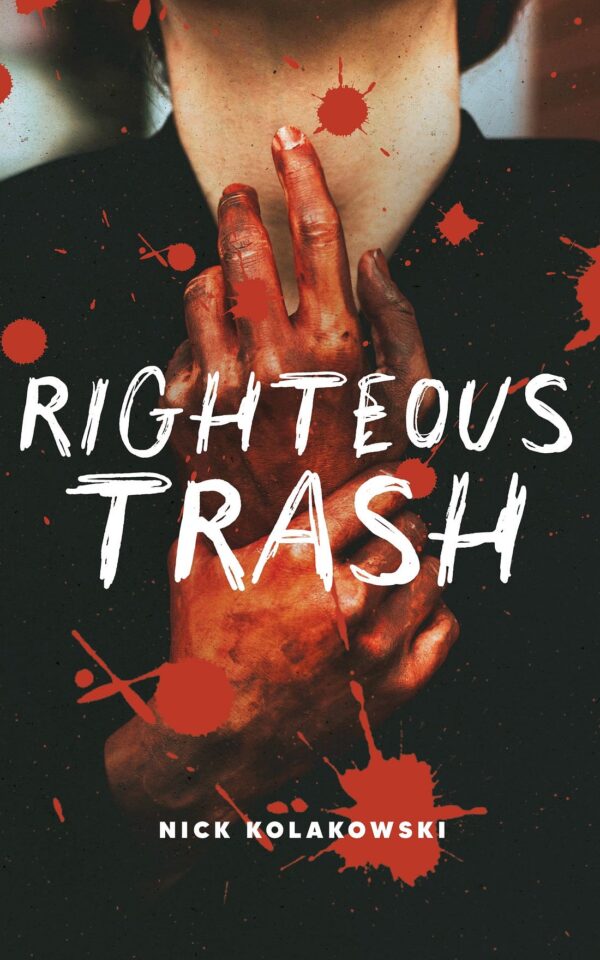
RIGHTEOUS TRASH follows Jake, an Iraq War veteran and former bounty hunter, and his gun-running sister Frankie as they try to dig themselves out of a big financial hole the only way they know how—by doing something incredibly insane and possibly deadly. »This time around, the action isn’t restricted to Idaho; there’s also a sequence set in New Orleans that’s a.) based on a real-life incident, if you can believe it, and b.) one of the funnier things I’ve written. The book’s centerpiece is also the craziest robbery I could think of—I had a lot of fun orchestrating that bit of chaos.«
His „Payback is Forever“ (Shotgun Honey 2022) is inspired clearly by the novels of Richard Stark. Our review here (in German). – See also his Hell of a Mess. A Love & Bullets Hookup.
Nick Kolakowski, geboren 1980, aufgewachsen in Washington. D.C., hat Geschichte in Chicago studiert. Er schreibt Romane, Kurzgeschichten, Lyrik und Essays, viele davon über Crime Fiction und verwandte Themen. Seine Texte erscheinen u. a. in der Washington Post, in Shotgun Honey, North American Review, The Evergreen Review, Rust & Months. Kolakowski lebt in New York City. Eine Besprechung des von Parker inspirierten „Payback is Forever“ in unseren Bloody Chops.

Bei Suhrkamp auf Deutsch: Love & Bullets.
His essays with us.
His website nickkolakowski.com
His column „Smoking Gun“ with us:
‘Salem’s Lot’ and the Horror of a Stephen King Adaptation
(27) „Rebel Ridge“: Calmly Burn the Whole Thing Down
‘Monsieur Spade’ and the Faustian Bargain
John Woo is Remaking ‘The Killer.’ But Why?
The Newest ‘Ripley’ Series is Stunning and Flawed
‘Sugar’: Not the Neo-Noir Revival We Need
(3) Moral Redemption in Noir: Is It Possible?
(4) What Makes Jack Reacher Tick?
(5) ‘True Detective: Night Country’ Tries to Make the Familiar into Something New
(6) Is David Fincher’s ‘The Killer’ a Comedy?
(7) Rewatching ‘Drive’: Gosling as Noir’s Apex Predator
(8) Elmore Leonard – City Primeval
(9) Cormac McCarthy Used Crime Fiction’s Tropes to Make Masterpieces
(10) Parker: Donald Westlake’s One Amazing Trick
(11) Cosby, Winslow, Pruitt: Three Heavy-Hitting Thillers for Summer
(12) Weed-Based Crime Thrillers are Going Up in Smoke
(13) ‘The Last of Us’: Crime in the Post-Apocalypse
(14) What Made “Glass Onion” and “Knives Out” So Popular?
(15) Jordan Harper’s One-Two Punch of Crime Fiction Deserves a Wide Audience
(16) ‘True Detective’ Season 2: Was It Better Than We All Thought?
(17) From ‘Touch of Evil’ to ‘True Detective,’ Long Shots are Crime Films’ Secret Weapon
(18) Michael Mann, again: What Michael Mann Teaches Us About Enduring Crime Fiction
(19) „Heat 2“ – How Do You Craft a Sequel to a Masterpiece?
(20) 4 Ways Tarantino’s “Once Upon a Time in Hollywood” Novel Stands Out From the Film.
(21) On „Heat“: Manhunter Takes Down Thief: How Michael Mann’s Early Career Led to ‘Heat’
(22) The Most Honest Nihilism – on „The Way of the Gun“
(23) No, Time to Die – The latest James Bond movie digs into the fatalism at the iconic spy’s core.
(24) Cormac McCarthy’s Overlooked Masterpiece? – „The Councelor“
(25) „Nightmare Alley“ – How Guillermo del Toro’s Film Alters a Masterpiece Noir Novel
(26) David Cronenberg – The Carnal Crime of “A History of Violence” and “Eastern Promises”
(27) With Parker, Donald E. Westlake Pulled Off Crime Fiction’s Most Spectacular Magic Trick
(28) Guy Ritchie’s Return to Crime Films is Worth Watching
(29) Alex Garland’s ‘Civil War’: Hint of Things to Come?
(30) David Lynch and the Beautiful Weirdness
(31) ‘Where the Bones Lie’ and the Engine of California Noir
(32) “Den of Thieves 2”: Stealing from the Best
(33) White Lotus and the Gentle Art of Hating Your Protagonists
(34) Neal Stephenson
(35) Where is Storytelling Going?
(36) ‚She Rides Shotgun‘ and the Making of Legends
(37) Jack Bauer, ‘24’ and the Great Memory-Hole
(38) How “Play Dirty” Did Richard Stark’s Parker Dirty
(39) ‘The Lowdown,’ Jim Thompson and the Ghosts of Noir
(40) “The Rip”: An Atypical Director Delivers a Typical Crime Thriller
(41) ‚Cape Fear‘ and Pop Cultural Eternal Return
(42) 3 x »Man on Fire«
(43) ‚The Black Dahlia‘ and Our Responsibility to the Past
(44) Jordan Harper’s New Novel Really Is “A Violent Masterpiece”
(45) Less is More When It Comes to Villains