Definitely a view from outside Occupied France
A review by Robert Wilson
We went to see Antonin Baudry’s ‘De Gaulle – Résistance’ last night and, unlike in France, the Hay-on-Wye audience age group was definitely 60 and above. The movie has gone ballistic with the young in France, as the country looks ahead to elections in early 2027 with Macron’s presidency ending while Marine Le Pen and Jordan Bardella wait in the extreme right wings.
The biopic movie takes us back to the terrible defeat of the greatest army in Europe who had no answer to Hitler’s rapid mechanised advance using tanks, planes and motorised troops. More surprising was the alacrity with which Marshal Philippe Pétain accepted defeat, surrendered and signed an armistice with Hitler, which gave the hero of Verdun ‘control’ of the Vichy half of France. De Gaulle was having none of it and boarded a flight to London where, practically unknown, solo and powerless he set himself up as the head of Free France.
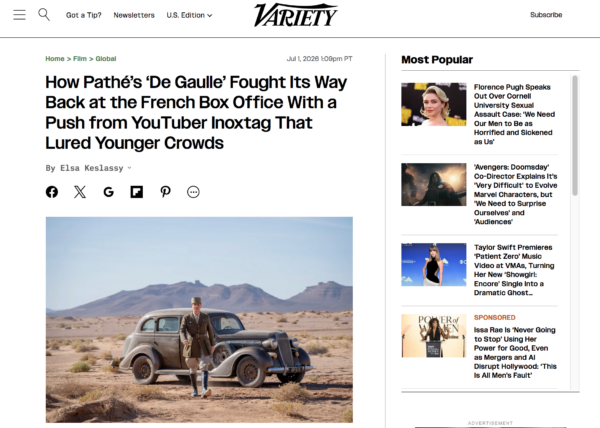
We have an early insight into the temperament of de Gaulle, brilliantly played by Simon Abkarian, as a monolithic monument of great height and rigidity who moves from the knees down and has almost no range of facial expression, but who leaves all he encounters in no doubt as to his complete intransigence in the face of…pretty much anything. On meeting terrified retreating troops de Gaulle, in a Citroen Traction Avante, leads his tanks into the hopeless battle and with extraordinary instinct tells his driver when to advance, when to leave the road, when to stop so that they avoid being hit by the German tank who has the vehicle in its sights. It is this mixture of intransigence and instinct that will serve him well in his meeting of minds with Winston Churchill.
Winston Churchill is played by Simon Russell Beale who awards him an outstanding French accent, which by all accounts WC did not have, and dresses not in his customary dark suits and bow ties but an eclectic range of burgundy dressing gowns, open-necked shirts and red jackets. He is drinking in almost every scene including cabinet meetings, which is perhaps slightly overstating the case. He relates to de Gaulle’s extraordinary arrogance and self belief and gives him sanctuary and access to the BBC where the General sets about riling everybody he can, but crucially inspiring the youth of France to stand up and protest. It is this ability to inspire that brings more senior figures to his side.
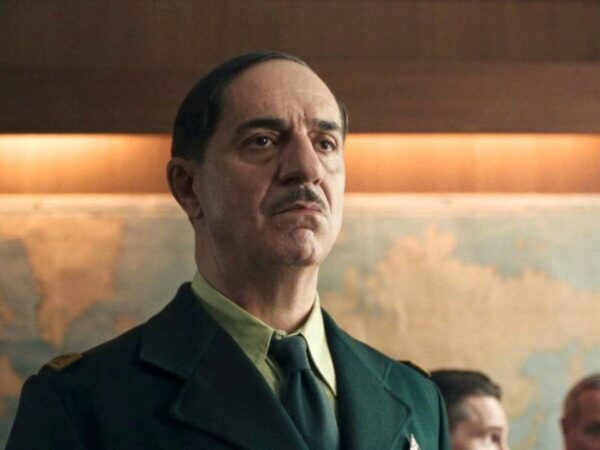
Simon Abkarian as De Gaulle 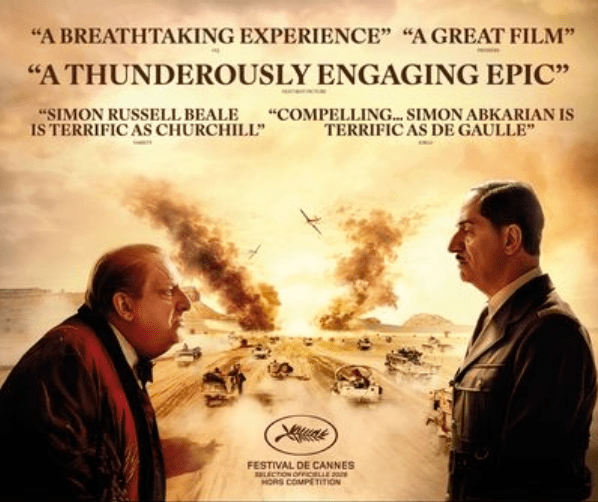
He and WC have an explosive relationship as the former decides that the French fleet, in danger of being co-opted by the Nazis, has to be taken out of the game at Mers el Kébir, and the latter is appalled by Allies killing each other. De Gaulle’s great problem is that the defeat of the army has left France bereft of fighting young men and no weaponry so a resistance movement is not immediately on the cards. Instead he sets about bringing the colonies onside starting with, of all places, Chad, then Cameroon and, not so successfully, Dakar.
This might seem a hopeless plan until WC finds himself in trouble in the Africa campaign and calls on the Free French to hold out in their desert fortress at Bir Hakeim while the 8th Army exits Libya and moves to Egypt. It is after this extraordinary 16 day resistance that WC renames the Free French the ‘Fighting French’ and de Gaulle’s future is assured.
There are some tremendous battles scenes both in the cabinet office where, after WC lets de Gaulle know where he stands, a chair gets violently trashed, and at sea and in the desert, especially at Bir Hakeim, where 3700 men faced a force ten times greater. The sub plot of French youth embodied by Fernand Bonnier de la Chapelle and a fictional brother and sister duo gives a brief insight into how tough things were in Occupied France resulting in Fernand escaping to Algiers where, ultimately, he makes his name.
This is very definitely a view from outside Occupied France. We are given only the briefest of glimpses of Pétain and Admiral Darlan, who becomes his PM, and none of the Vichy or Nazi darkness. There’s a single brutally terminated Paris protest and the Communists don’t feature. It is however, a fascinating, almost improbable, story of how de Gaulle, a mere colonel from a defeated army, lands in London as a nobody to become the leading light of France Libre and the inspiration of a generation. We look forward to seeing De Gaulle – Liberté next month.
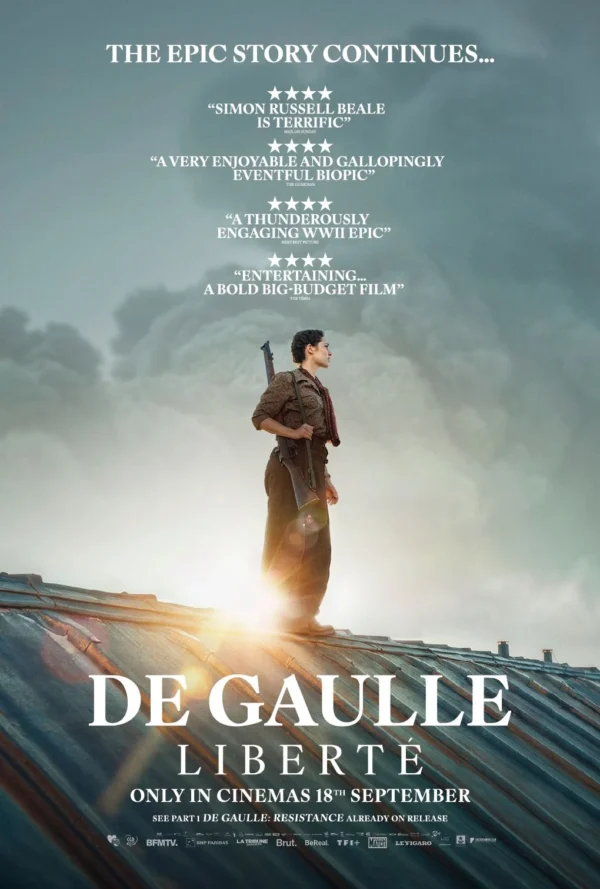
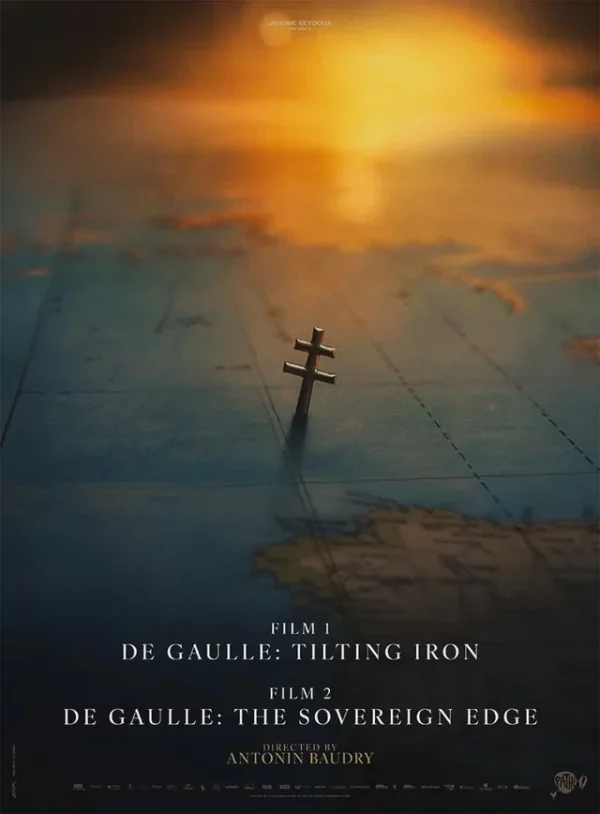
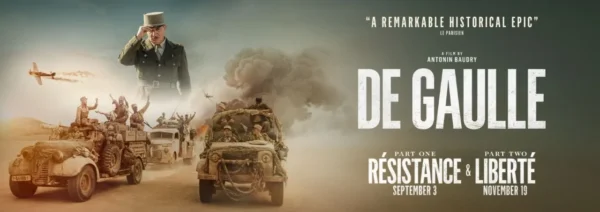
First poster – for Cannes ’26 
** **
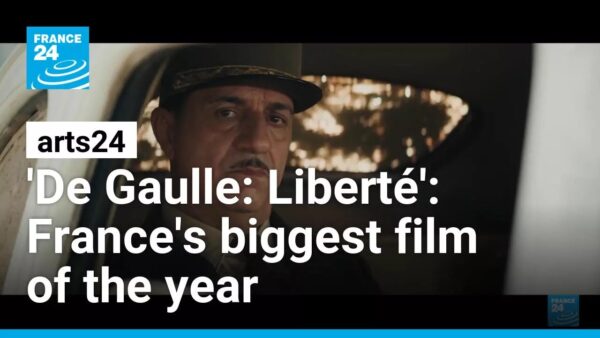
De Gaulle (La Bataille de Gaulle) is a 2026 two-part epic biographical drama film directed by Antonin Baudry, co-written with Bérénice Vila, and based on the nonfiction book A Certain Idea of France: The Life of Charles de Gaulle by Julian Jackson. It stars Simon Abkarian as Charles de Gaulle, and follows the general as a leading figure in the French Resistance during the Second World War. With a budget of €74 million its the biggest French film project of 2026. The two-parts were initially subtitled Tilting Iron and Sovereign Edge, but were later retitled for the international market as Résistance and Liberté.
The first part, De Gaulle: Résistance (158 minutes), also distributed as De Gaulle: Tilting Iron (L’Âge de fer, lit. ‚The Iron Age‘), had its world premiere out of competition at the 2026 Cannes Film Festival on 20 May, followed by its theatrical release in France by Pathé on 3 June. The second part, De Gaulle: Liberté (159 minutes), also distributed as De Gaulle: The Sovereign Edge (J’écris ton nom, lit. ‚I Write Your Name‘), was released in theaters in France on 26 June.
Pathé’s president, Jérôme Seydoux, had been developing the project to dedicate a major historical epic to General de Gaulle and Free France for around twenty years. A two-part film directed by Antonin Baudry about Charles de Gaulle was commissioned by Pathé in July 2021. It became one of the most expensive French films of all time.
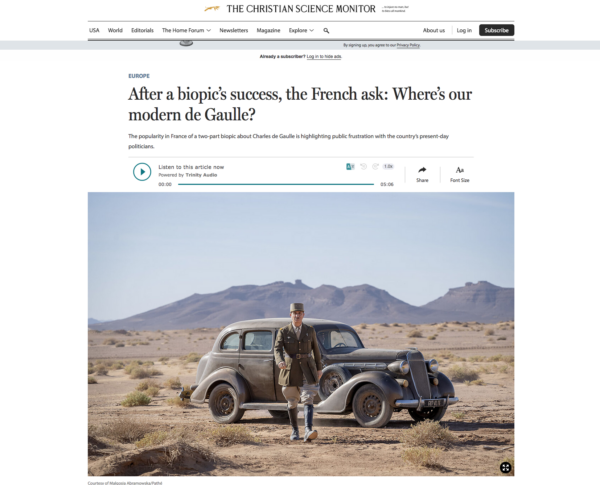
In Germany, the first part, named De Gaulle – Zeit des Widerstands, is planned for release on 4 February 2027 by a minor distributor. It stands to except that there won’t be much hype for it …
** **

Well-travelled Robert Wilson is the author of the Bruce Medway-, Charles Boxer- and Javier Falcon-novels. In 2003 his novel Tod in Lissabon (A Small Death in Lisbon) won the „Deutscher Krimipreis“. He has finished a manuscript for a WW II-thriller, set among the exiles in France and Portugal. He is a regular contributor to our End-of-Year-Issue. His appearance at CrimeMag here.
His essay about Vassily Grossman: Book of the Hour.
Svetlana Alexievich’s documentary book Second Hand Time.
His review of Booker Prize winner Douglas Stuart’s Shuggie Bain.
His review of Viet Thanh Nguyen’s The Committed.
Paul Lynch’s dystopian novel Prophet Song.