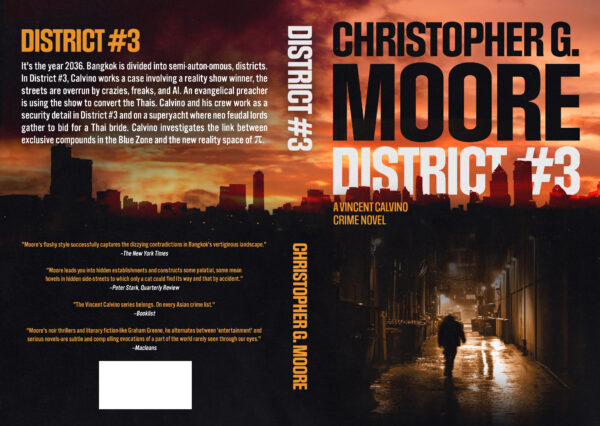
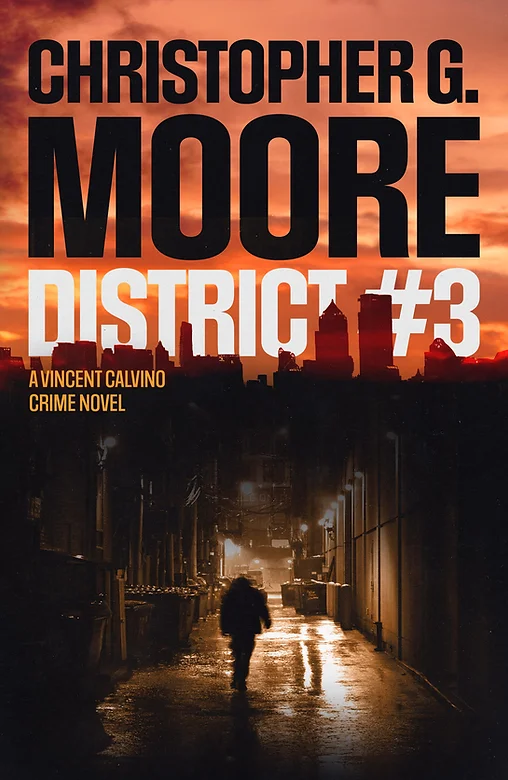
Christopher G. Moore: District #3. A Vincent Calvino Novel. Jacket design: Matt Gossen. Heaven Lake Press, Bangkok 2024. 398 pages, paperback edition, 16,69 Euro, eBook 6,36 Euro.
It is the year 2036. Like the rest of the world, Thailand has been irrevocably transformed by the full fury of climate change, leading to profound social and political upheaval. Bangkok, now a city of semi-autonomous districts, serves as a microcosm of this turmoil. In District #3, Calvino, a determined investigator, delves into the mysterious death of a reality show winner’s husband amidst a backdrop of chaos where crazies, freaks, Fliers, and Al agents roam the streets of Bangkok.
As extreme weather events wreak havoc on daily life, an evangelical preacher exploits the reality show to propagate his message among the Thai populace. Calvino’s role expands beyond mere investigation; he finds himself entangled in a celebrity security detail aboard an oligarch’s opulent superyacht. Here, neo-feudal lords gather to bid for a Thai bride and celebrate Freedom Day, illustrating the stark inequalities that have emerged in this new world order.
District #3 is a story in the tradition of Huxley’s Brave New World and Cormac McCarthy’s The Road. The narrative revolves around the fragile relationship between the powerful few and those who fight for survival. The neo-feudal lords gather for a lavish celebration while Calvino’s client becomes the entertainment. His investigation uncovers an unsettling connection between exclusive compounds in the Blue Zone and a groundbreaking reality space known as π.
The intertwining themes of climate change, social inequality, and political chaos are vividly depicted as characters navigate a social landscape marked by desperation and repression. Private eye Vincent Calvino’s client draws him into a case that offers him a front-row seat to the workings of an underground climate change resistance movement.
**
Here is our excerpt from Chapter One:
VINCENT CALVINO UNDERSTOOD that nothing of substance survived the churn of the daily news cycle— biblical floods, genocide, bombings, invasions, pandemics,starving refugees, and calls for violence slide across the screen. Yesterday’s AGI generated propaganda dissolved into the digital ether leaving no discernable trace. District 3 occupied a small space deep inside that snow globe. A place where time was slowly being stripped of memory and
humanity.
District #3 was the o#cial designation for an upscale area that snaked in and out, stretching from Soi 1 to Soi 101 Sukhumvit, with sections in the north and south of Sukhumvit Road. The districts had been carved out (on paper) into neat twenty-kilometer cubes (in reality it was more like a dog’s breakfast). District #3 was one of four that had security and fewer problems controlling crazies, freaks, or refugees. The residents had ID cards with bio information that were impossible to counterfeit.
There was an old Thai proverb that went along the lines of Nam “häng bpen pha long, din häng bpen seu,” which
translates as “In dry water, there are leeches; in dry land, there are tigers.” It re-emerged among the residents of
District #3 when they discussed the unpredictability of their lives in 2036. They told themselves, whether in water or on land, some predator, small or big, lay in wait to ambush them. No environment was safe or predictable anymore.
A thick dirty blanket of gray smoke seeped through the pores of the sweaty city. Seated in the back of an enclosed
electric golf cart, Calvino clutched a plastic bag with a garland of flowers wrapped in yesterday’s Bangkok Post. The scent of jasmine filled the interior of the golf cart. A small electric fan aimed at his throat circulated the stagnant but fragrant air. A line of sweat slipped down his cheek. He wiped it away.
The golf cart driver glanced in his rearview mirror. “Dok mali hom.” The jasmine, which had become exceedingly
rare, was valued for its lovely scent.
The slight movement of air made the heat almost bearable. Calvino opened a HeatMapping app to track hotspots to avoid. He checked the reading at Soi 8: Low of 40°C at 6:00 a.m., with an expected high of 48.1°C by 1:30 p.m. Extreme danger level. Work from home.
As the golf cart passed a shophouse, Calvino saw a familiar glass cage with a mouse inside and a camera recording its condition. Thousands of citizens uploaded such videos from their condo balconies so others could watch the mouse breathe heavily, its organs starting to fail as toxins spread through its small rodent body.
Other animals—frogs, chickens, pigs, cows, and geckos— were also filmed in the extreme heat. After the white mouse reality show, the gecko video feed was the most popular. Scientists, the psychotic type, ran experiments showing that the blood of a gecko boiled between 45°C and 50°C. People bet on how long the gecko could survive.
Stay inside. Don’t be a gecko. Don’t be a lab mouse. People weren’t fools. They knew a human’s blood boiled at 100°C. After a few hours at 48°C, the organs would fail, leading to cardiovascular collapse. No need to wait until the blood boiled—you’d be dead long before that happened.
Besides, it wasn’t just the heat behind the offcial warning to stay home. The underlying message was a darker
warning—that of an outbreak of violence on the street. It happened like clockwork every time the temperature,
dust, and humidity caused people to lose their minds. It was borderline unbearable in Bangkok. Calvino ignored
the advice. The cool-down periods of the day grew less frequent. If you waited for a cool day, you might wait a
long time.
December was the winter season in Bangkok. It had become a joke to wish someone a happy winter. Staying
locked in a condo for weeks on end had already caused a major bump in the suicide rate. People found it hard to
adapt to the lava-like conditions that were no longer limited to the inside of a volcano.
“If you’re going out, make certain you drink lots of water,” Ratana had said, watching him check the clip from his Dan Wesson DWX 9mm. Colonel Pratt had given it to him as a birthday present the previous summer. They’d
gone target practicing with the new gun. It would get the job done. She’d held out a second fully loaded 9mm clip.
“Don’t forget this.”
He nodded as he threaded his arm through the shoulder holster. Any conversation more than half an hour ultimately returned to dehydration stories of splitting headaches, bone-aching fatigue, and head-spinning dizziness. Everyone seemed to know someone who’d died of dehydration. There was little water content in the corpses burnt at the wats. The bodies went up like a dry forest.
Ratana had watched her boss, one hand around the red grip, the other busy checking the magazine of his 9mm handgun. “And watch out for the crazies. Heat makes them crazy.”
Calvino regularly passed them as they shouted from pedestrian overpasses, squatting on bamboo mats, their meager belongings scattered around them, the open sores on their legs and arms, matted hair, and unshaved faces testifying to their condition. They heard voices; they had visions from nightmares that tailed after them during the heat of the day. Homeless and alone, they screamed, shaking their fists at invisible phantoms. No one bothered to rob or assault them. They owned nothing of value. They were just lost souls howling at the gods for forsaking them.
The Age of Cruelty began around 2031, after an underground ecowarrior group calling themselves “Artemis” blew eight international flights out of the sky. The planes, all headed to Don Mueang or Suvarnabhumi Airports, were carrying over three thousand passengers and crew. The wreckage con!rmed the terrorists had used FIM-92 Stinger shoulder-fired missiles as part of a coordinated drone attack. Both airports were immediately locked down and temporarily closed. Suvarnabhumi was later mothballed. That was the year Bangkok was divided into a dozen new districts.
People were more careful now. No one let their guard down on the street. All it took was a few seconds of
inattention, something the crazies sensed, and they were on you. Like a walking point in the jungle, there was an ambush waiting around the next turn on the path. Calvino thanked old New York, the one from his youth, for preparing him. Without those early street survival lessons, he would have been dead and buried long ago.
In this time of heat madness, he inhaled the scent of jasmine and, for a moment, felt himself in a place of calm,
beauty, and peace. He looked at the flowers. Nothing was lost by an offering of dok mali to stay on the right side of the spirits. He promised Ratana that his first order of business would be to offer the garland at the spirit house that stood at the entrance to the tailor’s shop on the soi.
The electric cart moved silently and slowly. The driver turned and stuck his nose through a small opening in the
plastic separating him from his passenger and inhaled the scent of jasmine. The scent lifted his spirits. His eyes were half closed, and a smile was on his face. Whether Ratana’s flowers would appease the spirits guarding the tailor’s shop was an entirely different question.
A dome of thick smoke carried by the wind from distant wildfires settled over the high-rises and shopping malls.
The days of burning sugar cane !elds continued. But there were fewer fields to burn. The new fires were worse—out of control, covering a large region, raging for weeks on end—and the toxic smoke clung to the nose and lungs.
Some fires were intentionally set, while others ignited due to negligence, with most caused by the extreme heat in the remnants of forested areas.
The golf cart passed restaurants, bars, and massage parlors. Some were boarded up while others displayed ‘For Sale’ signs. Boarded-up shops told a story of failure and despair. Faded menus, brittle with age, waited for customers who had abandoned the soi—except for a handful of regulars who carried on as if nothing much had changed. If they noticed the change in the soi, they would have read a different story. Most of the businesses had an armed security guard posted outside. The guards were hit or miss in their sense of duty. Most just worked for food. You often found them sleeping in that fitful, uneasy twilight slumber in a spot of shade.
The occasional man or woman darted across the road in front of the golf cart. Once clear, they’d stop and stare. A
couple of the crazies they passed held up tattered Bibles and ran after the cart yelling, “Jesus is your savior!” But despite their devotion, they lacked the strength to chase after a minute. The heat pulled them to their knees. Something of a Christian revival had gained a footing among a segment of the population in District #3. The weirding of the weather was thought to be an omen for a vocal minority who embraced a new generation of religious leaders. Extreme weather spread a firestorm of extreme beliefs and rituals.
But there it was, the weather changed; people changed too, but not everyone. Many in District #3 resented them and cursed them. And most feared them.
“Fucking Bible people,” the driver said as he made a sharp turn to avoid one of the beggars, a rake-thin man with no shirt and festering boils on his chest. The beggar had waited until the last moment to propel himself at the golf cart. He bounced o$ the side and fell face down on the road. The driver didn’t stop. It was an old trick. A half dozen others would have suddenly appeared and attacked Calvino and the driver. If lucky, they’d only lose their belongings.
If unlucky, Calvino patted his holster, he had an equalizer. The better-off ones were easy to spot with their bodies
shiny and wet from sunblock and sweat. Their shorts and tank tops were loose-!tting on malnourished bodies, their
faces covered with soiled surgical masks—months old and the color of cement—not as protection against the latest virus, but from inhaling the !ne particles in the fetid air that had killed off much of the elderly population. And for many, the masks were a way to hide their identity. They were ashamed of what they had become.
A motorcycle delivery driver cut in front of the electric golf cart. On the back of the motorcycle was an electronic
billboard. A drone camera must have captured Calvino’s face, or perhaps AI had located the IP address on his phone, because the screen began flashing personalized advertisements for Vincent Calvino: “You’re invited to join
our exclusive community in Indra’s Net Room! The π portal for those seeking interconnectedness. Find your Authentic Being. Be reborn into Cosmic Freedom.”
GeoPersonalService ads were a normal feature in District 3. The AI plugged you into a vast database, updated hourly, and predicted what products or services you would buy based on the information scraped from your text
messages, email, video platforms, and voice messages. The old technology of !xed surveillance cameras had gone to the Museum of Old Tech and was placed next to the fax machine exhibit.
Next on the screen, an ad featured happy partygoers, smiling, well-dressed young people with perfect teeth and smiles. An attractive woman handed out gummies. Underneath a running scroll advertised, “We have all flavors: strawberry, orange, mango, and many more. Our Rave Chewable Gummies are loaded with THC 22 to 27 to ensure uninterrupted bliss.”
The gummy ad dissolved into a flashy neon light ad with a beautiful woman singing. The script below—”Don’t miss
the spectacle of the year at EmSphere: Reserve your tickets now for her new show—Malee Unbound.” The advertisement faded to a provocative photo of Malee on stage, in the spotlight, wearing a black dress slit up to her hip.
The screen ended with a personalized message: “Happy Shopping Vincent Calvino.” The electric cart slowed as it
edged past a security guard sitting in a plastic chair under an awning near the entrance to a hotel. Rake thin, the guard was doubled over from coughing. Behind the security guard, a lottery vendor had a sneezing !t, ripping o$ her mask and gasping for air. Everywhere he looked, Calvino saw the miserable, exhausted, hungry, and unhinged.
The electric golf cart driver braked as he pulled to the curb. Calvino climbed out. He paid for his ride, then unwrapped the newspaper, removed the flowers, and gave one to the golf cart driver. The elderly driver placed his palms together and made a slight bow, the traditional wai greeting of Thailand. Jasmine symbolized purity and simplicity. A reminder of a lost world. Placing flowers at a spirit house in Thai culture was the way to gain merit with
the spirits protecting the land.
As the golf cart pulled away to return to the top of the soi, Calvino noticed a Yamaha YZF-R1M pulled to a stop in front of the hotel opposite the tailor’s shop. “You don’t get much change out of a million baht for that,” thought Calvino. The Thai leaning over the motorcycle handlebars and his passenger looked like twins in their matching aviator glasses, blue jeans and jackets, and Adrenaline GTS 22 running shoes. These guys were not crazies or freaks. They had money. They broadcast a look that screamed they had a commander watching their back.
…
##

Novels in the Vincent Calvino crime fiction series:
Spirit House/ Asia Hand / Zero Hour in Phnom Penh / Comfort Zone / The Big Weird / Cold Hit / Minor Wife / Pattaya 24/7 / The Risk of In!delity Index / Paying Back Jack / The Corruptionist / 9 Gold Bullets / Missing in Rangoon / The Marriage Tree/ Crackdown / Jumpers / Dance Me to the End of Time
Other novels:
A Killing Smile / A Bewitching Smile / A Haunting Smile / His Lordship’s Arsenal /Tokyo Joe / Red Sky Falling / God of Darkness / Chairs / Waiting for the Lady / Gambling on Magic / The Wisdom of Beer / Reunion
Non-fiction:
Heart Talk / The Vincent Calvino Reader’s Guide / The Cultural Detective / Faking It in Bangkok / Fear and Loathing in Bangkok / The Age of Dis-Consent/ A Memory Manifesto / Rooms
Anthologies:
Bangkok Noir / Phnom Penh Noir / The Orwell Brigade.